
Having explored search technologies for almost a decade, I can honestly say nothing has been as disruptive as the recent rise of Retrieval Augmented Generation (RAG). This system is revolutionising search and information retrieval using vector search with generative AI to produce direct answers based on trusted data.
In my search projects, experimenting with RAG has led me to consider its potential enhancements; I believe RAG is still too limited to meet users' needs and needs an upgrade.
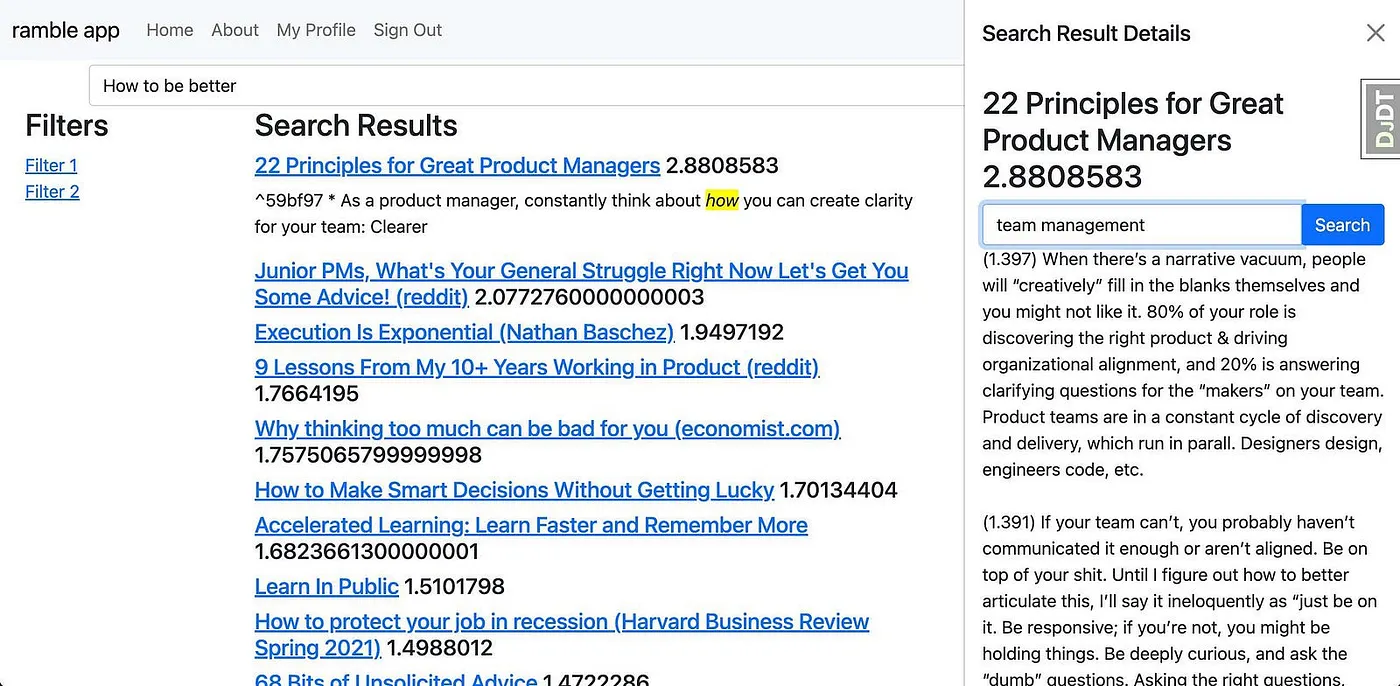
Don't get me wrong, RAG is excellent and is absolutely a step in the right direction for information retrieval technologies. I've used RAG since the advent of GPT-2 in 2021, which has significantly helped boost my productivity when looking for valuable information from my own notes or work documents. RAG has many advantages:
- Vector Search Fusion: RAG introduces a novel paradigm by integrating vector search capabilities with generative models. This fusion enables the generation of richer, more context-aware outputs from large language models (LLMs).
- Reduced Hallucination: RAG significantly diminishes the LLM's propensity for hallucination, making the generated text more grounded in data.
- Personal and Professional Utility: From personal applications like sifting through notes to more professional integrations, RAG showcases versatility in enhancing productivity and content quality while being based on a trustworthy data source.
However, I'm finding more and more limitations of RAG:
- Constraints with Current Search Technologies: RAG is limited by the same things limiting our retrieval-based lexical and vector search technologies.
- Human Search Inefficiencies: Humans are not great at writing what they want into search systems, such as typos, vague queries, or limited vocabulary, which often lead to missing the vast reservoir of information that lies beyond the obvious top search results. While RAG assists, it hasn't entirely solved this problem.
- Over-Simplification of Search: Our prevalent search paradigm linearly maps queries to answers, lacking the depth to understand the multi-dimensional nature of human queries. This linear model often fails to capture the nuances and contexts of more complex user inquiries, resulting in less relevant results.
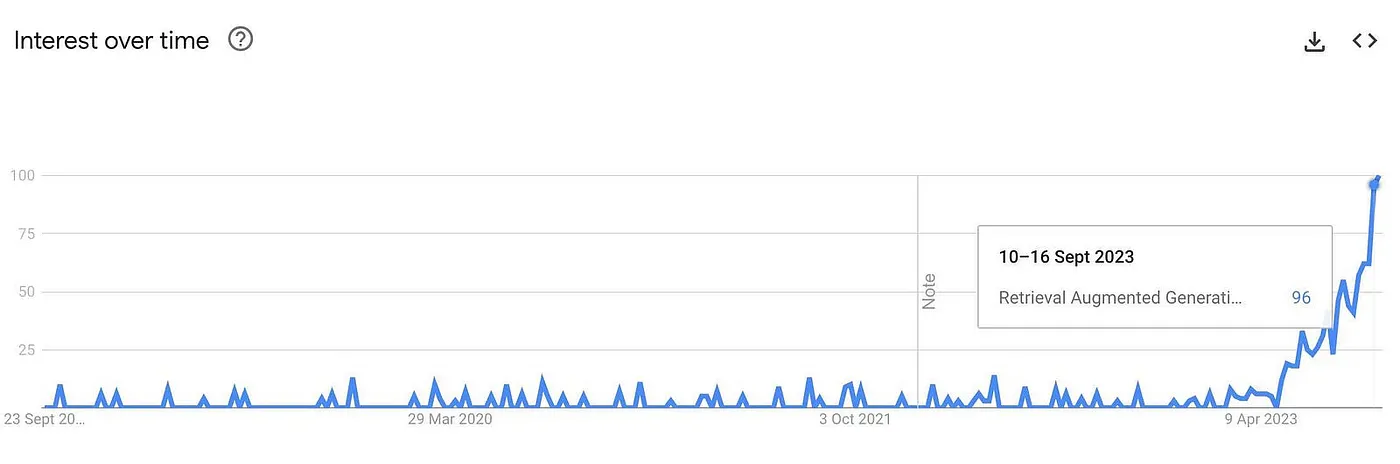
So, what can we do to address these issues? We need a system that doesn't just retrieve what we ask but grasps the nuance behind our queries without needing ever-more advanced LLMs. Recognising these challenges and inspired by the possibilities, I developed a more refined solution: RAG Fusion.
Why RAG Fusion?
- Addressing Gaps: It tackles the constraints inherent in RAG by generating multiple user queries and reranking the results.
- Enhanced Search: Utilises Reciprocal Rank Fusion and custom vector score weighting for comprehensive, accurate results.
RAG Fusion aspires to bridge the gap between what users explicitly ask and what they intend to ask, inching closer to uncovering the transformative knowledge that typically remains hidden.
Embarking on this journey with RAG years ago, I regret not sharing those initial experiments. But it's time to make amends. Let's delve deep into the technical intricacies of RAG Fusion.
A Deep Dive into the Mechanics of RAG Fusion
Tools and Tech Stack
FYI, for those of you who just want to see code and get straight into playing with RAG Fusion, check out the GitHub repo here.
The foundational triad of RAG Fusion is similar to RAG and lies in the same three key technologies:
- A general-purpose programming language, often Python.
- A dedicated vector search database, such as Elasticsearch or Pinecone, steering the document retrieval.
- A potent large language model, like ChatGPT, crafting the text.
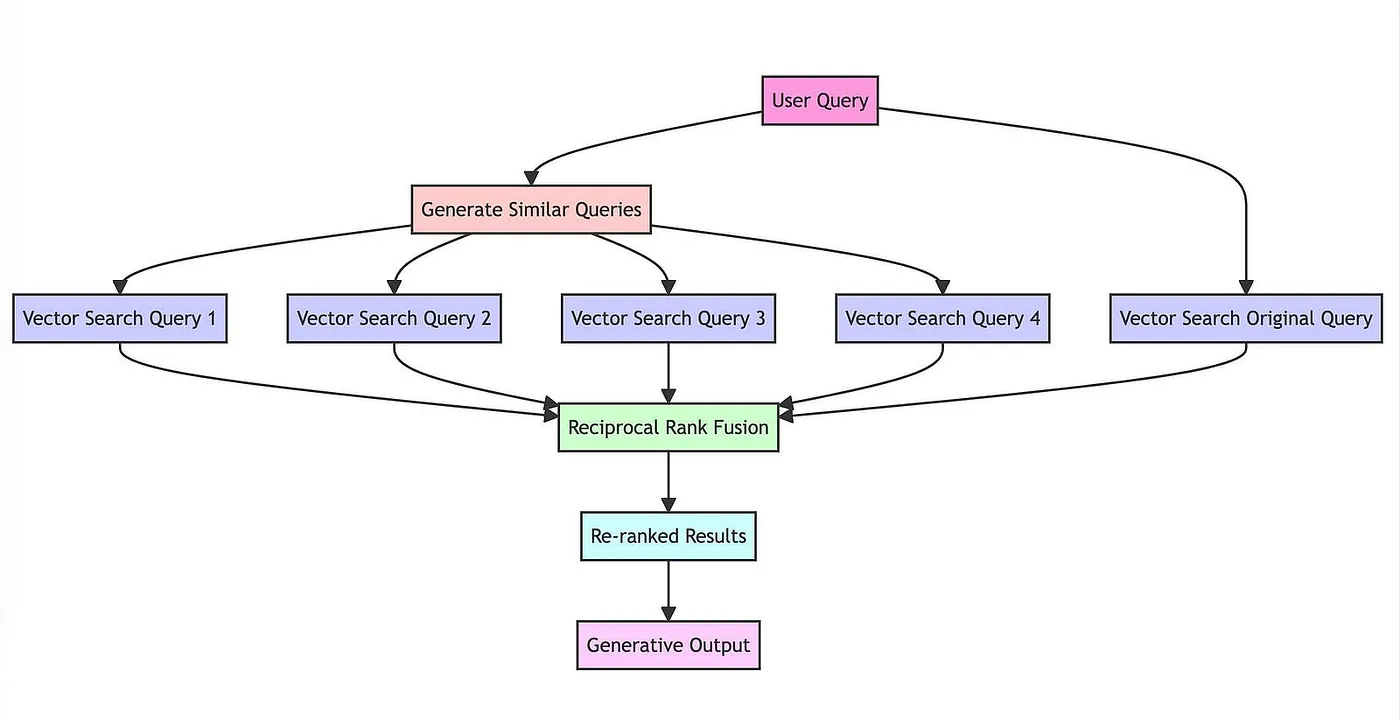
However, unlike RAG, RAG Fusion differentiates itself with a few additional steps, query generation and a reranking of the results.
RAG Fusion's Workflow:
- Query Duplication with a Twist: Translate a user's query into similar, yet distinct queries via an LLM.
- Vector Search Unleashed: Perform vector searches for the original and its newly generated query siblings.
- Intelligent Reranking: Aggregate and refine all the results using reciprocal rank fusion.
- Eloquent Finale: Pair the cherry-picked results with the new queries, guiding the large language model to a crafted output that considers all the queries and the reranked list of results.
Let's walk through each of these steps in more detail.
Multi-Query Generation
Why Multiple Queries?
In traditional search systems, users often input a single query to find information. While this approach is straightforward, it has limitations. A single query may not capture the full scope of what the user is interested in, or it may be too narrow to yield comprehensive results. This is where generating multiple queries from different perspectives comes into play.
Technical Implementation (Prompt Engineering)
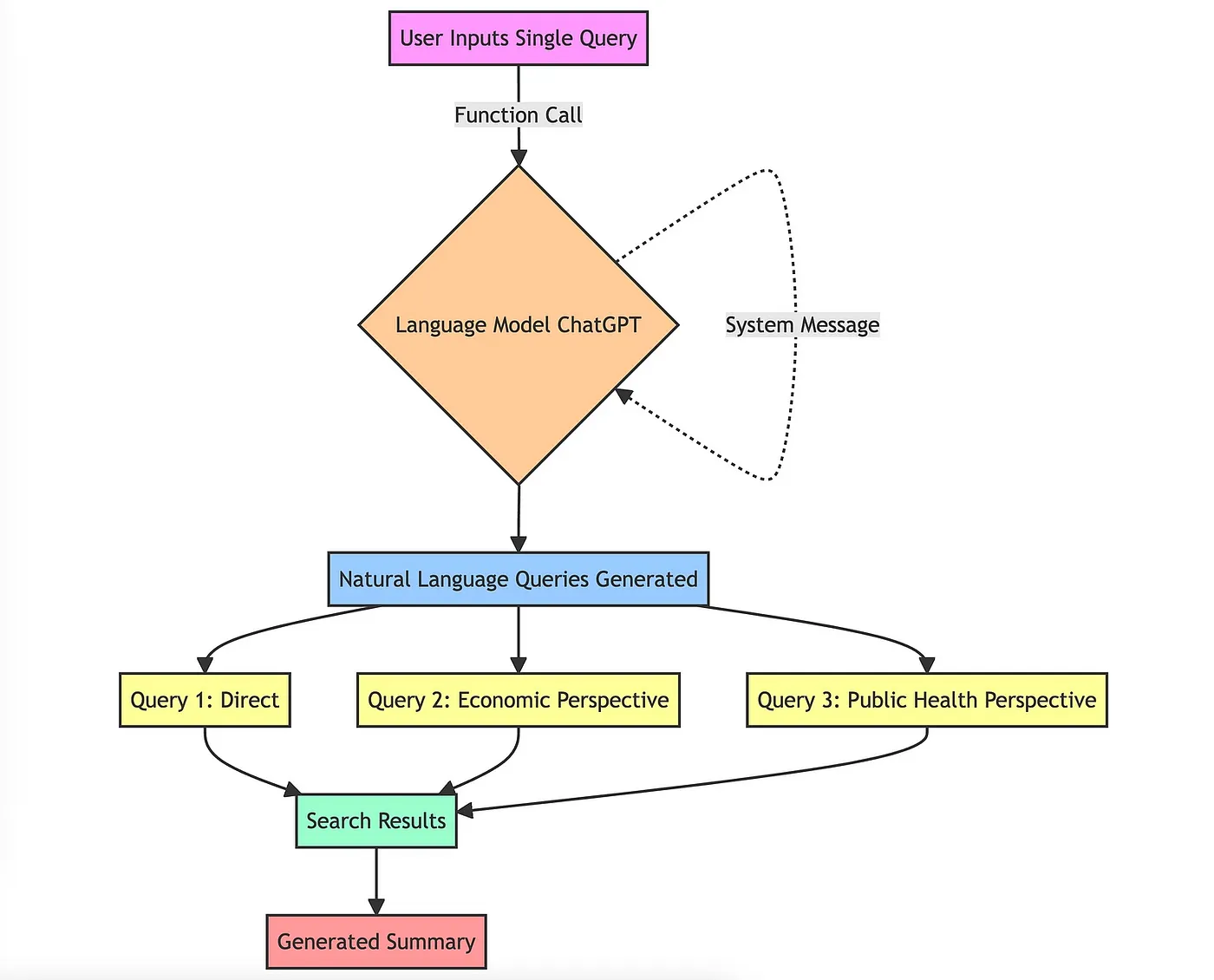
The use of prompt engineering is crucial to generate multiple queries that are not only similar to the original query but also offer different angles or perspectives.
Here's how it works:
- Function Call to Language Model: The function calls a language model (in this case, chatGPT). This method expects a specific instruction set, often described as a "system message", to guide the model. For example, the system message here instructs the model to act as a helpful assistant.
- Natural Language Queries: The model then generates multiple queries based on the original query.
- Diversity and Coverage: These queries aren't just random variations. They are carefully generated to offer different perspectives on the original question. For instance, if the original query was about the "impact of climate change," the generated queries might include angles like "economic consequences of climate change," "climate change and public health," etc.
This approach ensures that the search process considers a broader range of information, thereby increasing the quality and depth of the generated summary.
Reciprocal Rank Fusion (RRF)
Why RRF?
Reciprocal Rank Fusion (RRF) is a technique for combining the ranks of multiple search result lists to produce a single, unified ranking. Developed in collaboration with the University of Waterloo (CAN) and Google, RRF, in the words of its authors, yields results better than any individual system, and better results than standard reranking methods.
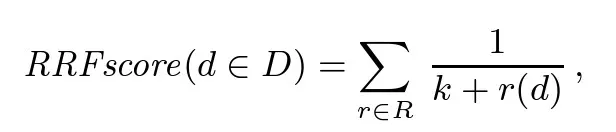
By combining ranks from different queries, we increase the chances that the most relevant documents will appear at the top of the final list. RRF is particularly effective because it doesn't rely on the absolute scores assigned by the search engine but rather on the relative ranks, making it well-suited for combining results from queries that might have different scales or distributions of scores.
Typically, RRF has been used to blend lexical and vector results. And although that method can help make up for the lack of specificity of vector search when looking up specific terms like acronyms, for example, I've been unimpressed by the results, which tend to be more of a patchwork of multiple result sets because the same results rarely come up for the same query for lexical and vector search.
Think of RRF as that person who insists on getting everyone's opinion before making a decision. Only in this case, it's not annoying but helpful. The more, the merrier, or, in this case, the more accurate.
Technical Implementation
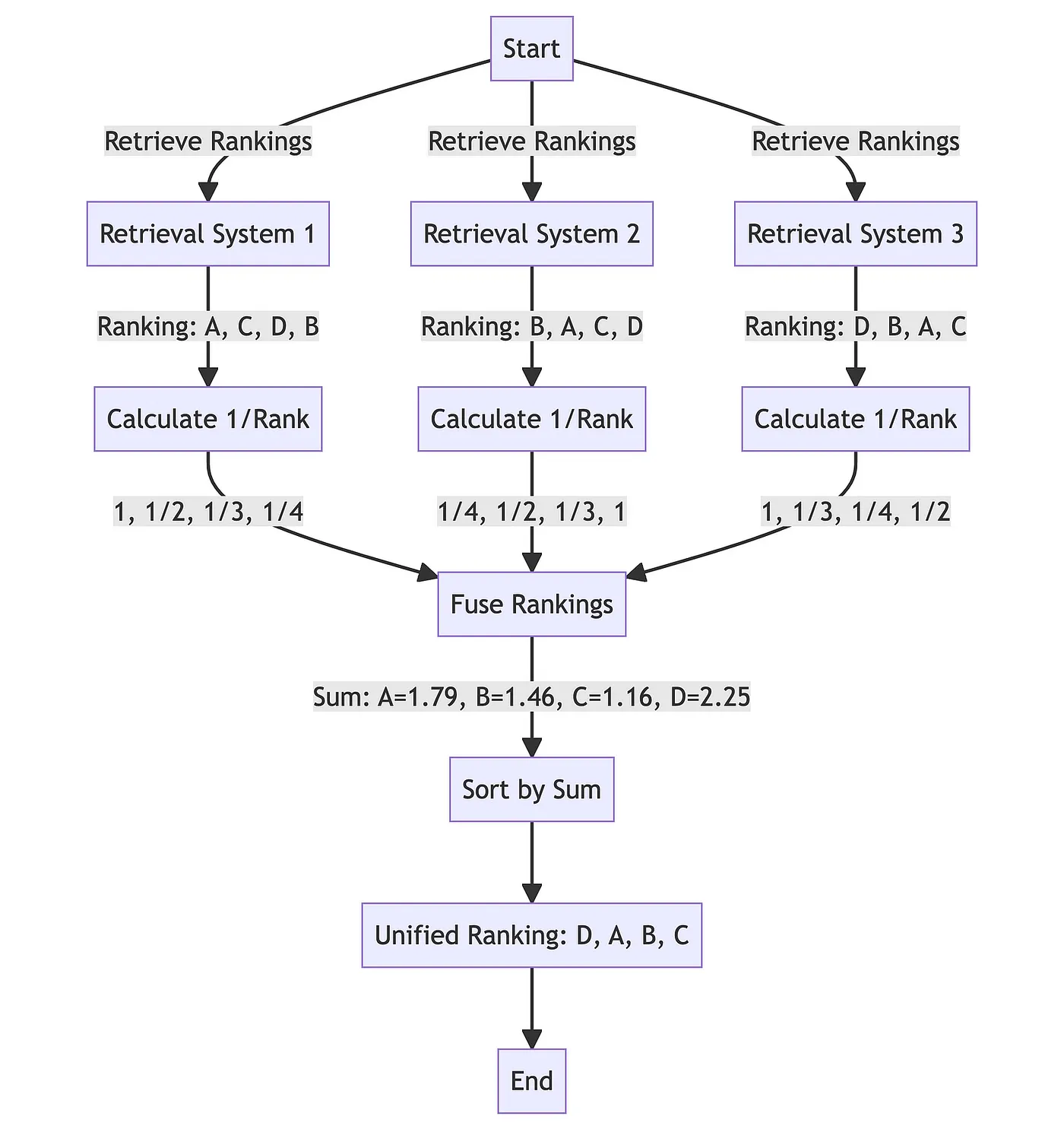
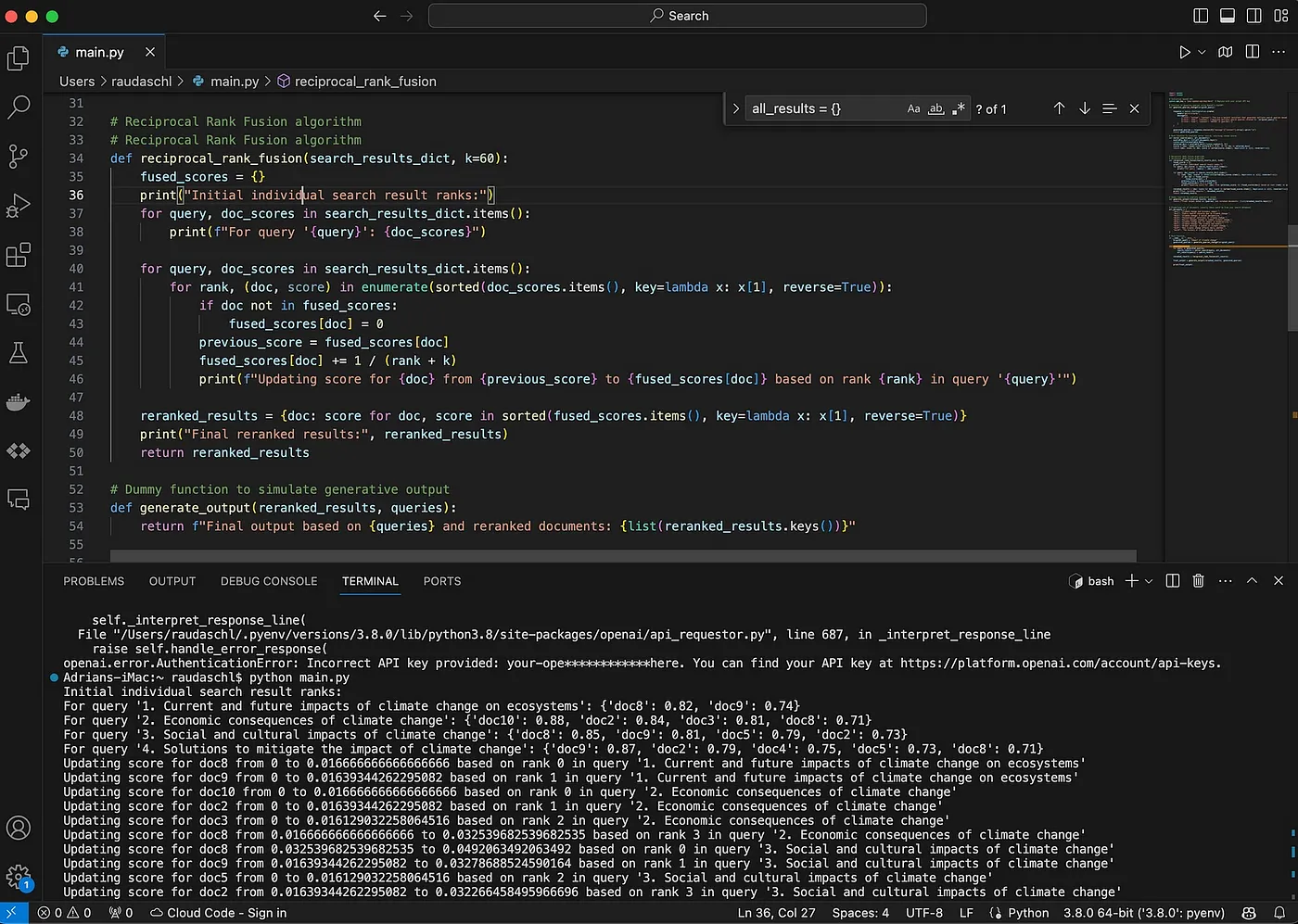
The function reciprocal_rank_fusion takes a dictionary of search results, where each key is a query, and the corresponding value is a list of document IDs ranked by their relevance to that query. The RRF algorithm then calculates a new score for each document based on its ranks in the different lists and sorts them to create a final reranked list.
After calculating the fused scores, the function sorts the documents in descending order of these scores to get the final reranked list, which is then returned.
Generative Output and User Intent Preservation
One of the challenges in using multiple queries is the potential dilution of the user's original intent. To mitigate this, we instruct the model to give more weight to the original query in the prompt engineering.
Technical Implementation
Finally, the reranked documents and all queries are fed into an LLM prompt to produce the generative output in a typical RAG way, like asking for a response or summary.
By layering these technologies and techniques, RAG Fusion offers a powerful, nuanced approach to text generation. It leverages the best of search technology and generative AI to produce high-quality, reliable outputs.
Strengths and Shortcomings of RAG Fusion
Strengths
1. Superior Source Material Quality
When you use RAG Fusion, the depth of your search isn't merely 'enhanced'; it's amplified. The reranked list of relevant documents means that you're not just scraping the surface of information but diving into multiple perspectives. The structured output is easier to read and feels intuitively trustworthy, which is crucial in a world sceptical of AI-generated content.
2. Enhanced User Intent Alignment
At its core, RAG Fusion is designed to be an empathic AI that brings to light what users are striving to express but perhaps can't articulate. Leveraging a multi-query strategy captures a multifaceted representation of the user's informational needs, thus delivering holistic outputs and resonating with user intent.
3. Structured, Insightful Outputs
By drawing from a diverse set of sources, the model crafts well-organised and insightful answers, anticipating follow-up questions and preemptively addressing them.
4. Auto-Correcting User Queries
The system not only interprets but also refines user queries. Through the generation of multiple query variations, RAG Fusion performs implicit spelling and grammar checks, thereby enhancing search result accuracy.
5. Navigating Complex Queries
Human language often falters when expressing intricate or specialised thoughts. The system acts as a linguistic catalyst, generating variations that may incorporate the jargon or terminologies required for more focused and relevant search results. It can also take longer, more complex queries and break them down into smaller, manageable chunks for the vector search.
6. Serendipity in Search
Consider the "unknown unknowns"; information you don't know you need until you encounter it. RAG Fusion allows for this serendipitous discovery. By employing a broader query spectrum, the system engenders the likelihood of unearthing information that, while not explicitly sought, becomes a eureka moment for the user. This sets RAG Fusion apart from other traditional search models.
Challenges
1. The Risk of Being Overly Verbose
RAG Fusion's depth can sometimes lead to a deluge of information. Outputs might be detailed to the point of being overwhelming. Think of RAG Fusion as that friend who over-explains things; informative, but occasionally, you might need them to get to the point.
2. Balancing the Context Window
The inclusion of multi-query input and a diversified document set can stress the language model's context window. Picture a stage crowded with actors, making it challenging to follow the plot. For models with tight context constraints, this could lead to less coherent or even truncated outputs.
Ethical and User Experience Considerations
With great power comes great responsibility. And with RAG Fusion, the power to manipulate user queries to improve results feels like it's crossing into some kind of moral grey zone. Balancing the improved search results with the integrity of user intent is crucial, and I've got some thoughts you should consider when implementing this solution:
Ethical Concerns
- User Autonomy: The manipulation of user queries can sometimes deviate from the original intent. It's essential to consider how much control we're ceding and at what cost.
- Transparency: It's not just about better results; users should be aware if and how their queries are adjusted. This transparency is essential to maintain trust and respect user intent.
User Experience (UX) Enhancements
- Preserving Original Query: RAG Fusion prioritises the initial user query, ensuring its importance in the generative process. This acts as a safeguard against misinterpretations.
- Visibility of Process: Displaying generated queries alongside final results provides users with a transparent look at the search's scope and depth. It aids in building trust and understanding.
UX/UI Implementation Tips
- User Control: Offer users an option to toggle RAG Fusion, allowing them the choice between manual control and enhanced AI assistance.
- Guidance & Clarity: A tooltip or brief explanation about RAG Fusion's workings can help set clear user expectations.
If I had to encapsulate the value of RAG Fusion, it would be this: it moves closer to what AI was always supposed to do, amplify human potential.
RAG Fusion is not merely an advancement; it's a clarion call to all innovators. It beckons us to step beyond conventional frameworks and reimagine the tapestry of "search".
To those in the realm of search, I pose a challenge: Let's not merely create search systems; let's architect interpreters of inquiry.
Hopefully, RAG Fusion inspires you to take up that challenge with me.
Dive into the GitHub repo, get your hands dirty with the code, and join the revolution.
You have to start with the customer experience and work backwards to the technology (Steve Jobs)
Bibliography
- If you want to read more on the subject, I strongly recommend reading "AI-Powered Search" by Trey Grainger, Doug Turnbull, and Max Irwin.